Showing posts with label Bible. Show all posts

Tuesday, November 20, 2007

Famous or Infamous?


Earlier this year I began looking for a new Bible.  I had been more than a little disappointed with my most recent purchase which at that time was a little more than a year old, a Life Application Study Bible.  It is a large book at 6.5" x 9.5" x 2", bound in bonded leather and the spine is glued.  The price of the Bible was around $70.00 which to me at that time seemed like a lot to spend on a Bible but thought it was an investment.  Sadly the Bible didn't last quite as long as I had expected.  Thus began my search for my next Bible.

I started looking for a new study Bible as well as a new translation.  I decided on The Reformation Study Bible(ESV) but along with it I also was interested in and bought the 1599 Geneva Bible after reading a review by J. Mark Bertrand.  He had an entire section in his blog that was all about Bibles, nice Bibles.  I read and re-read all he had written about Bibles and I finally had an understanding of what a fine binding was.  Ever since buying my first Bible I wanted a truly nice Bible but didn't have an idea of what that was as most Christian bookstores do not usually stock premium Bibles.  

Thankfully there are companies that still make these very expensive books and people like Mark Bertrand who take the time write about and photograph them.  He now has a new site that is strictly dedicated to this pursuit.  Here, Bibliophiles can talk about the aspects of Bibles and Bible design that are of interest.  Recently, one of the regular commentators to the blog sent a picture of his stack of Bibles to Mark.  After posting in the comments section all of my recent acquisitions, Mark asked me to send him a picture of my Bibles so he could write about as well.  Read it here

I guess this sort of shopping spree is unusual.  Hmm, thats just odd!

From top to bottom; 1) Cambridge Pitt Minion NASB goatskin,  2) Cambridge Cameo KJV blue Morocco,  3) Lockman Wide Margin NASB blue calfskin,  4) Crossway Deluxe Heirloom ESV black calfskin,  5) Crossway Single Column Reference ESV black calfskin,  6) R L Allan Reference ESV black Highland goatskin,  7) Crossway Thinline Cordovan ESV calfskin,  8)  Lockman Wide Margin NASB black calfskin

J. Mark Bertrand is my homeboy!

Monday, November 12, 2007

Bible Paper. Too Thin or Not Opaque Enough?

In the previous post on Crossway's Single Column Reference Bible I did something that led me to write this. I used to work as a machinist in the aerospace industry, although that didn't last long I still have some of my old tools including my micrometers. Since I was writing about the SCR and the biggest issue in the minds of possible customers to this fine Bible is the thickness of the paper. I brought out my two micrometers, one is a cheap, no name brand $20 throw away that I haven't yet thrown away. The other is a Swiss made Etalon Series 260 model 71.115899

It took me a little longer than expected to re-learn how to read these micrometers. I measured the paper on the SCR and it came out to .0017" thick. I measured the paper carefully so as not to damage the paper nor to compress the paper and get a bad reading. There is a chance I didn't read the micrometer properly but that may not be as important as long I was able to demonstrate a difference between various Bible paper.  I decided to measure all my Bibles and found something very interesting. The paper used on the SCR is not the thinnest and it seems to be the standard. I measured paper from several different publishers and paper thickness is not the culprit as much as opacity is. I have discussed the right type of pens to use for writing in your Bible but there are those that do not write in their Bibles yet bleed through is still an issue for them.

I am not an expert on paper. I know that is made of wood pulp along with other items such as cotton or linen, binders and chemicals to whiten or color the paper. Bible paper is made thin for obvious reasons, the Bible is quite a lengthy book. Were it to be made with regular book paper the Bible would be about 3" thick. Imagine trying to street witness with a Bible that is over 3" and weighs over 5 lbs.

.0013"-
Cambridge Pitt Minion Reference Bible NASB.

.0013"-
Classic Thinline Reference Bible ESV.

.0013"-
Tyndale Life Application Study Bible NKJV.

.0014"- Cambridge Cameo King James Version (out of print)

.0017"-
Tolle Lege 1599 Geneva Bible.

.0017"-
Lockman Foundation In Touch Ministries Wide Margin Edition NASB.

.0017"=
R L Allan Cross Reference ESV.

.0017"-
Ligonier Ministries The Reformation Study Bible ESV.

.0017"-
Crossway Single Column Reference Bible ESV.

.0020"
Crossway Deluxe Heirloom Bible ESV.

The Deluxe Heirloom is sadly out of print. After the remaining stock on hand is sold there will not be any more made. This Bible was printed on 27 lbs. paper with wide margins and a 10.2 size font, a great edition for note takers. Of the Bibles with the thinnest paper, there wasn't one that was noticeably more opaque than the other, well the Life Application Study Bible appeared less opaque than the Pitt Minion or the Classic Thinline. This may be due to the size difference between the two smaller Bibles and the massive LASB. Of the Bibles that measured in at .0017", the Wide Margin NASB from The Lockman Foundation was nearly as opaque as the thicker Deluxe Heirloom ESV. The RSB the Geneva Bible and the ESV from Allan's all appeared about equal in opacity and just slightly less opaque than the Lockman NASB and the Single Column Reference Bible slightly less opaque than the previous three. I believe that the SCR was printed on 21 lbs. paper and the Thinline on 19 lbs. The weight of the paper is measured by weighing 500 sheets of 25" x 38" sheets. I have no objective way of measuring the opacity of the paper and simply went by my eyes. In case it matters I have 20/20 vision.

I hope that Bible publishers will realize the importance of providing a quality product and that there are a few whom are willing to pay extra for owning great books. I do not know the price difference in using thicker or more opaque paper per Bible. The opacity of the paper is increased by the use of titanium oxide. I am sure that the use of thicker or more opaque paper will make for a more expensive Bible... but how much more expensive? Crossway and Cambridge both make Bibles that are near or over $200 but can be found for anywhere between $90 and $150. R L Allan make some truly fine Bibles but the ESV in Highland goatskin is, depending on the exchange rate, $175.00. They have editions that are over $200. Clearly there is a market for truly premium Bibles. I used an inexpensive Bible for many years even though I wanted a "better" Bible, I didn't know exactly what a "better Bible" was. Most bookstores, Christian or not, do not usually carry these premium editions. Most people do not demand for better because they do not know better is available. That may be why cheaper and cheaper paper is used and why very few publishers offer sewn bindings and premium leather covers, not that hard plastic that is being passed for genuine leather. The surprise of all the Bibles I measured was the Cameo KJV from Cambridge. This is an old Bible from the late '70's. It's paper is 0014" and is just as opaque as Deluxe Heirloom ESV whose paper is .0020" thick.

If you build it, we will come.

Wednesday, November 7, 2007

ESV Single Column Reference Bible... Or The Myth of The Too Thin Paper


Truth be told, I am a little late jumping on the ESV bandwagon.  So I have decided to drive my own bandwagon.  This is not the first review of the Single Column Reference Bible in the ESV translation published by my friends over at Crossway/Good News Publishers.  I will be reviewing the SCR in black premium calfskin leather and will attempt to give more than a perfunctory review.  Yes, I am a fan of the ESV translation but it is not the only translation I use nor is it the only one I recommend.  I think everyone should use more than one translation, including the KJV, NASB and NIV.  I also recommend the use of a Bible quiver, more than one Bible for specific use.
  
By God's good grace we live in a time and place when where we can own a Bible let alone a plethora.  Believe it or not, there are places on this planet where Bibles are outlawed and have to be smuggled in.  Trying to keep things in perspective, there are saints that are happy to have just one Bible. One!  They probably do not care if it's a paperback or hardback, genuine leather or Trutone or whatever proprietary name is given to the fake leather.  They are happy to own a Bible,  lest we forget what a luxury we have.  I say this only because there seems to be too much nit-picking about Bibles.
  
This leads me to why I have decided to write this blog.  The internet, like most other things have very good aspects to them that can easily be exploited.  In the dark ages b.p.c (before personal computers) news travelled much... much slower than it does today.  News used to take hours, yes... hours to get to us, now with everybody owning computers and with new technological advancements like the Apple i-Phone you can get news as it is happening no matter where you are.  Another thing that travels at the speed of life, aside from the news, are myths and urban legends.
 
Far too many Bible reviews are simply bogus.  According to Rick Mansfield there are 84 translations or paraphrases of the Bible in English.  Aside from all the translations available there are different bindings, covers, colors and sizes to choose from.  If that wasn't enough, you can also get a Bible that's made specific to your needs such as a Soldiers Bible, Marines Bible, Adventure Bibles, Blossom Complete New Testament, Duct Tape Bible, Revolution: The Bible For Teen Guys Bible, Mom's Devotional Bible, True Identity Bible and even a Woman Thou Art Loosed Bible... I am not joking.  It is safe to say that there are Bibles that fill just about every niche out there, although I am still looking for a Too Fat and Too Old to Skateboard Bible in the SCC Version (So Cal Cholo.)  

Since there are countless combinations of translations, bindings, covers, colors and sizes to choose from it is ridiculous to give a Bible a bad review for something that it was not intended for.  I've seen people give a thinline Bible a bad review for having thin paper, or a compact Bible for having type too small for reading.  If you are are willing to use only one Bible then you will have to compromise.  If you want a Bible with large print set in a paragraph format with study notes, cross references, concordance and maps... you may have to give up portability.  Judge a Bible for what it's intended purpose is.  Study Bibles tend to be large and bulky, compact Bibles are small and portable.  It's unreasonable to give a Bible a poor review for something it wasn't designed for so buy the Bible that suits your need.


Which leads me to Crossway's Single Column Reference.  According to many reviews, it appears to suffer from paper that is too thin.  Too thin for the purpose of note taking. Having been made with wide margins, note taking seems to be what it was made for.  More on the paper, later.


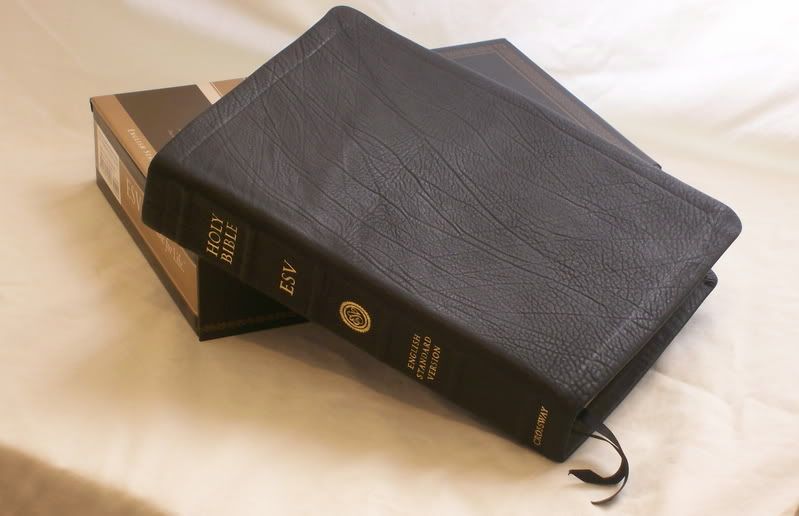
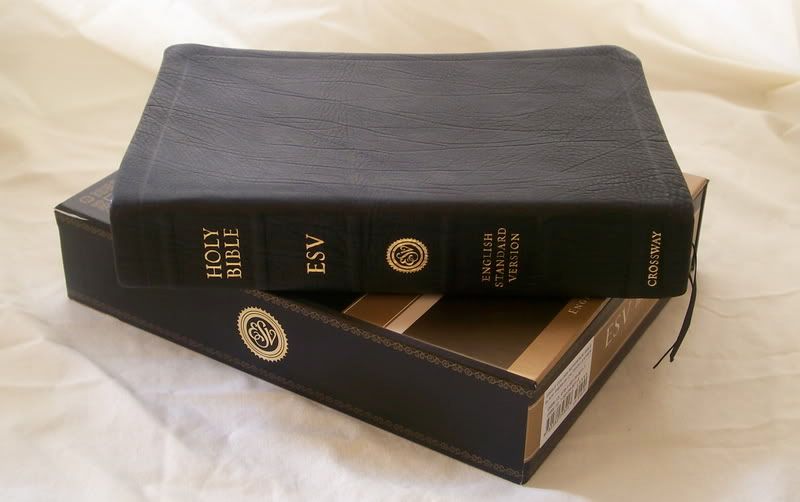
The SCR was released earlier this year and features the ESV translation with the minor updates from 2006 which, really are very minor.  The calfskin used by Crossway is among the best leather available by any publisher.  The black calfskin is a matte black, it doesn't have the sheen that the goatskin leather on Cambridge or R L Allan Bibles.  The cover is cut slightly larger than the book block itself and it is also leather lined making the covers very limp and durable.  This copy has very soft leather with grain that is striated and a smell that is wonderful.  The spine has 6 raised bands giving it that "old world craftsmanship" look.  The stamping on the spine is precise, clean and straight.  The leather cover itself is framed by a line that has been rolled or stamped  1/2" inside of the edge.  When open, the book stays that way no matter where its opened to, in the hand, it feels like an old broken in baseball glove, an extension of your hand.  This has much to do with the a binding that is smyth sewn, making this a Bible that will probably out last me.


The book block itself is 6.5" x 9.25" x 1.5", the leather cover is slightly larger but not a true semi-yapp.  The Bible has color maps in the back with presentation page, marriage, birth and death page in the front.  As with all ESV Bibles I have seen, this one has the preface which speaks of the history and philosophy behind the ESV translation as well as a section that gives an explanation to the features, such as how to use the cross references as there are over 80,000 of them.  The Bible also features a concordance with over 14,500 entries.  All this goes to make a very usable Bible for the purpose of in-depth studies.

Another feature that will help in making this a usable Bible is the readability.  The font size is 10 point which some may say that it should be larger but because of the setting is more than enough to make this a very easy read.  The layout of the page is not cluttered, the verses are not crammed and the cross references are on the inside margin making this a very neat layout.  The chapter introductions are brief and are printed in a shaded portion at the top, as each chapter starts a new page.  The chapter title, also at the top of the page and it's in a font different than the verses.  

The feature that sets this Bible apart from many on the market is the single column setting.  Most Bibles available are in a double column setting with cross references in the middle, this one however has the cross references on the inside margin and there is only one column of verses.  Each verse starts a new line and there are paragraph marks to let the reader know when a paragraph starts.  The space between the verses is roomy, especially in the poetic portions of the Old Testament.  The side margins are a little more than an inch wide which is plenty of room for me to make my notes, but others may need slightly wider margins. The verses are bracketed by a thin line at the top, bottom and along the side inside of the cross references which is a very aesthetically pleasing detail.  The type is distinctive and very readable even at arms length.  

Now, to the paper.  Everywhere from blogs to the comments section at Amazon, people mention the paper being too thin and it suffering from too much bleed through.  This is a matter that has been blown out of proportion by a vocal few and been carried along by those that have yet to handle this book in person.  This to me is a very subjective matter, although there is bleed through, it is not as distracting as some have suggested.  If bleed through is an issue, this may not be the Bible for you but if it is something that is not so important.  In my opinion it is not much more than other Bibles and for as good a Bible as this is, it something that should be overlooked.  If you are going to take notes in this Bible do not use highlighters, use pigment liners to underline.  Not only will they not bleed through they will keep your Bible looking neat.  For writing your notes use the 005 and for underlining do not use anything bigger than a 03, 01 or 02 are preferable.  The 01 will appear as dark as the print itself from the other side.
 

Paper too thin?  I don't know, maybe.  As I said thats a subjective matter.  What I can tell you is that I dug out my old micrometers and measured the thickness, well, attempted to measure.  It's been such a long time since I had used them I am not sure if I read them correctly but the paper is .0017" thick.  There is some bleed through but it's not distracting and if you use the right pens, underlining and note taking will not be a problem.  You can even use colors that will be less not noticeable than black, be sure to try them out prior to use in less visible spot like the concordance to be sure you are happy with the results.   The only issue I have with this Bible is the ribbon markers, much too thin for a book this big, aside from that, kudos to Crossway for putting together a very elegant and useful tool for the study of Gods Word. 

Check out the WTS Bookstore for the best price on the Single Column Reference ESV.


Sunday, October 21, 2007

What to use for writing in your Bible


Writing in your Bible is something that many people do but few do it judiciously.  Many people only mark their Bible according to what they hear from the weekly sermon and after a while they underline or highlight everything making the actual process of marking your Bible pointless.  There are many people that do not make any additional marks in their Bible and some even consider it heresy.  I believe that if done properly marking in your Bible can be a very useful way to better understand the Word of God.

Wide margin Bibles were made for just such a purpose.  They have a wider margin than most Bibles and are usually printed on thicker paper to avoid any bleed through when using pens or highlighters.  Even though you don't have a wide margin Bible you can still underline and make small notes in whatever Bible you own.  
So now that you want to write in your Bible, what to use?  First I will tell you what not to use.  Do not use hi-liters.  Aside from looking ugly they are usually too fluid and bleed through to the other side of the page that may make it a bit distracting.  After a while the pages look like one big fluorescent stain.  The ink in most cases is not of archival quality thus over time the ink will degrade the paper.  Dry mark highlighters are nothing more than colored pencils.  I do not recommend the use of pencils as they can fade or smudge but more than that, they also damage the paper.  Bible paper is thin and if you use a pencil or a even a ball point or roller ball pen you will dent the sheet you are writing on as well as a few pages below.  If you have used pens or pencils in the past you will be able to feel the words on the back side of the page you wrote on.  

No pencils, no pens, no highlighters... 'den what?  Archival quality pens.  These pens are a type of technical pen used by engineers or draftspersons.  They are cheaper and more durable than most technical pens and can be found at most art stores as well as large office supply stores.  They have a long metal tip with a soft writing nib which is ideal for using with a ruler.  The soft nib also helps prevent damaging the paper or denting the pages you are writing on.  You have to press really hard to make the sort of indentations you can easily make using a pen or a pencil.  
The biggest reason for using an archival quality pen is the ink, or rather the pigment.  These pens use pigment ink rather than dye ink.  Pigment ink is chemically stable, its pH is neutral, it is non-acidic and non-alkaline so it will not cause the paper to degrade over time.  The pigment molecule is also larger than the dye molecule.  It will outlast dye ink under extreme sun exposure... not that any of you will leave your Bible open for days at a time the next time you visit the Sahara but at least your notes will not fade.  The larger pigment molecule is not just less susceptible to degradation it also helps in preventing bleeding or spreading which is a plus when you consider the thickness of most Bible paper.  The pigment stays on the surface of the paper more than dye inks.  The stability of the solvent used for the ink will prevent it from bleeding even if you wet the paper, it dries instantly so it is nearly impossible to smudge.

There are three brands of archival quality pens. Staedtler Pigment Liner, Prismacolor Fine Line Marker and Sakura's Pigma Micron.  All are high quality pens available with different sized writing nibs with the Prismacolor and Sakura available in different colors as well.  With most publishers using lower and lower quality Bible paper using these pens will help in keeping your notes and markings looking neat.  With the thicker paper used in wide margin Bibles I use the 05 size for underlining and the 005 for writing my notes.  On thinner paper I wouldn't suggest using the 05 or anything thicker as it may be too visible from the other side.  Stick to using the thinner nibs like an 03.  You can also use one color to underline and another to write your notes or you can come up with you own system.  I use these with my ESV Deluxe Heirloom Reference Bible which was printed on 27lbs. paper.  The 05 is slightly visible from the other side where as my notes using the 005 are barely noticeable. 
 
These pens will be useful for those looking for an alternative to highlighters, pens or pencils.  They will help in keeping your markings looking neat and are a great way to help you in your studies of the Word. 

Wednesday, October 17, 2007

ESV Bibles. Great Bible, Good Buy


If you are not familiar with the relatively new Bible translation being published by Crossway, the English Standard Version (ESV), I highly recommend that you consider using it.  The ESV is an "essentially literal" translation that holds to the literary qualities of the King James Version from 1611 while being nearly as accurate as the NASB, which is often knocked for sounding "wooden".  Although a very literal translation the NASB at times suffers form sentence structure that doesn't flow well.  The ESV, while being a literal translation like the NASB, is easier to read and retains the poetic qualities found in the KJV.  The ESV is also more literal than the NIV while being just as easy to read.

If you are considering the ESV, take a look at the bookstore at Monergism.com.  Their online bookstore has recently been updated and they have added to their lineup of ESV Bibles.  Of note are the calfskin Bibles.  Although expensive, calfskin Bibles from Crossway are some of the nicer Bibles you can buy.  Not only are these premium leather Bibles nice to look at they are very well made and will outlast less expensive ones.  The key with these calfskin Bibles is not only the super nice covers but the fact that they are have smyht sewn bindings which will allow these books to lay flat on a table or fit your hand like a glove while you sit in during Sunday morning service.  

Monergism is currently offering the Classic Reference in black calfskin and cordovan calfskin as well as the Classic Thinline also in black calfskin and cordovan calfskin.  These prices are the best you're gonna find, even better than Amazon.  Currently they are offering free shipping 'til Reformation Day... that's October 31st for the non-Reformed.  

I own the Classic Thinline in cordovan calfskin and I highly recommend it.  Look for a full review at a later date.

Monday, August 20, 2007

Crossway's New Personal ESV


Crossway has recently announced that they will be releasing a new ESV Bible in early '08. The Personal Size Reference Bible will fall in the ESV lineup between the Classic Reference ESV and the Compact ESV. It's dimensions are 5" x 7.25" with a font size of 7.4. It is almost identical to the old Cambridge Cameo edition which is currently out of print. Crossway's site doesn't mention how thick it will be but I am going out on a limb and say it will be close to 1.25" thick.

The reason for excitement about this new edition is not so much the convenient size but it's format. It will be a single column paragraph edition with the references along the margins. Sample pdf. A single column edition is laid out like a traditional book which will be a plus in the ease of read department as well as helping with the flow. If all publishers used a single column paragraph format, I think it would help with people taking verses out of context... one would hope!

Crossway uses their type setting for making more than one edition. This current type setting will be available in four styles to start with, a black genuine leather and three Tru-Tone colors, black, mint and chestnut. If this edition sells well, I hope Crossway will make more editions with this setting. First, in premium calfskin leather and in the future a wide margin edition of at least an inch with slightly larger font also in calfskin, preferably in goatskin, smyth sewn, lined in leather so the covers are floppy. I dream of such a Bible

Wednesday, August 8, 2007

What was old is new again!


The Geneva Bible is an English translation first published in 1560. It's name is a reference to where the work of translating, compiling and commenting took place. The Bible was primarily a Protestant translation and the work took place in Geneva because at the time, Queen Mary I, whom was a Catholic, was persecuting the Reformers. There was an exile of these Puritans and Reformers to mainland Europe but most made their way to Geneva. The work of translating the Bible into English was a continuation of the work that had been done by William Tyndale but he was later burned at the stake for his "treason" and "heresy" against the Roman Catholic church. After his death in 1536, his work was taken up by Myles Coverdale, William Whittingham, Anthony Gilby, William Cole and several others. All with the help of John Calvin and Theodore Beza. The Geneva Bible was used by John Milton, William Shakespear, John Knox, John Donne, John Bunyan, author of Pilgrim's Progress and Oliver Cromwell. This is the Bible the Pilgrim's brought with them on the Mayflower and for much of the 16th and 17th, was the most popular English translation of the Bible. It was even more popular than the King James version for many years after it's initial publication in 1611.

King James was not a fan of the Geneva Bible, as it was the first study Bible with marginal notes which were anti Catholic as well as not supporting the sovereignty of the monarchy. For this reason he sought to replace it. In fact it was the first Bible to use numbered chapter and verse, the first to have the notes in the margins written by the Reformers. It also used a modern Roman Typeface as opposed to the harder to read Black Type or Gothic typeface, which the later King James Version used. Another popular feature was it's size. It was relatively compact when compared to other Bibles availabe at the time. It measured approximately 8 3/4" x 5 1/2", which is smaller than my ESV Deluxe Heirloom Edition by Crossway. Eventually, the King James Version or the Authorized Version took over in popularity and this great translation was almost forgotten, only availabe in recent years as an expensive facsimile edition beautifully bound in leather by L.L. Brown.

Enter Tolle Lege. A small publisher that undertook the restoration of this wonderful translation. It is now available with modern type and with modern spelling of the 16th century English. Whereas the KJV has undergone several updates, leaving behind the original translation of 1611 the Geneva Bible is now availabe in all it's original greatness. Tolle Lege makes four versions available and they are currently on their third or fourth printing. They have a hardback, leather bound and two special editions, one is a large Family Edition the other is a Calfskin Edition. The paper is thin but quite opaque with very little bleed through. The leather version is 6" x 9 1/4" x 1 1/4". It is smyth sewn so it is a good candidate for rebinding in goatskin, more importanly, because it is sewn it lays flat. It has one ribbon marker and the pages are gilt. My only complaint is that some of the pages have lighter printing than others and there are few typos that will be rather hard to pick out but I am sure that have been taken care of with the more recent printings. This is something to overlook when you consider the historical value of this translation.

The best thing about this Bible is the translation. It is very similer to the King James, or rather the KJV is very similar to this one but it is all together different. Not necessarilly better, just different. In my opinion, it reads more modern than the KJV even though it is 51 years younger. There are certain colloquialisms that are not found in the KJV like the use of "breeches" in Gen 3:7 rather than "aprons" used in the KJV or the use of "buggerers" rather than "sodomites". It does have a glossary of archaic words making the reading easier. By Gods good grace, this great translation of His word is available again.

Wednesday, August 1, 2007

Another quiver.


Hopefully I have been able to persuade you to consider more than just using one Bible translation because now I'm going to present to you the idea of owning more than one Bible of the same translation.

Isn't one Bible enough?

Yes, one Bible is actually all you really need, but having more than one may be of use. Obviously if you only use your Bible for Sunday service then your problems cannot be solved by owning more.

There are four sizes or types that may be of use, starting with a study Bible, a wide margin Bible, a hand size Bible and a compact Bible.

Starting with a study Bible as these tend to be big and heavy. I would not recommend these for carrying around to church or Bible studies but only for home study where it's size and weight won't be an issue. Look for one that has a sewn binding. Since study Bibles are larger, a sewn binding will help keep a Bible of this size together, longer. I would not recommend the Life Application Study Bible as it is one the largest study Bible available but the binding is glued and not sewn. The Reformation Study Bible put out by Ligonier Ministries is a study Bible in the ESV that has a sewn binding, as does the 1599 Geneva Bible. Although not presented as a study Bible, it does contain notes from the English Reformers of the 1500's like John Knox and Miles Coverdale as well as the Reformers in Geneva like John Calvin. Study Bibles should be used for home study use along side of your Bible of regular use. Remember, the study notes are not inspired and are to help you get through some theological issues. Consider getting one in hardback as most modern bonded leather or genuine leather covers are about as stiff as cardboard and feel just as bad.


The other Bible you should consider is a wide margin Bible. The wide margins are for you own personal notes, to make your own study bible. These Bibles usually have paper that is slightly thicker than regular Bible paper but that does not mean that the ink will not bleed through, so choose your pen wisely. Being able to make your own study notes will be helpful in that they will be study notes on matters that are important to you, not a bunch of advisors. You can make notes for your teaching or for sermons, for apologetics or for evangelism. Whatever they are, they will be your notes. Of the wide margin Bibles available there are a few I can recommend. Cambridge makes some of the finest Bibles you can buy. They make wide margin Bibles in the KJV, NIV and the NASB by August of 2007. Cambridge Bibles have sewn bindings and are availabe in a variety of covers including goatskin. Although goatskin is expensive, it is the best leather available for binding. The Lockman Foundation make an NASB wide margin Bible called the In Touch Ministries WIde Margin, they have sewn bindings and are bound in calfskin. They are soft and very durable. Crossway currently offers a wide margin Bible in the ESV but not in a premium leather. They also make a Deluxe Reference Bible which has wide margins and a larger font (10 point vs. 8 point) than the wide margin ESV... though the margins aren't quite as wide. This Bible was offered in calfskin but is now out of print. That is too bad becasue it is a great book. I found one after they went out of print, and I am very pleased with it. The hardback and leather are still available, just not the premium calfskin model.


The next Bible to consider is a hand size Bible. This of course is quite subjective as some may say that a study Bible in my hands would look like a compact Bible in the hands of an "average" sized person. This is a Bible that you can use for taking to Sunday service or to Bible studies. You don't need a big heavy Bible with a dictionary, concordance, maps, cross references, etc. You are not going to sit in the middle of a sermon and begin to do all of your cross references and word studies. Save that for when you get home and continue your studies. This Bible should be thin and light but also look for a font size that is large enough so as to be easy to read. Those with poor eye sight will have their choices limited.

If you are looking for a KJV in personal size or hand size there a few publishers that can help you out. Starting with Thomas Nelson Publishers, Nelson's Signature Series which are smyth sewn and bound in calfskin. They have an ultra slim edition that is expertly made. The covers are thick leather that is buttery soft, these are also leather lined. This size is also availabe in the NKJV. Cambridge makes a plethora of Bibles in the KJV but there are two that fit the criteria. The Cameo edition which is currently out of print but is excpected to be re-printed later this year and also the Concorde edition. The Concorde is the larger of the two and both are available in different covers, the best being the goatskin in which the Concorde is leather lined as well. Last is RL Allan of Glasgow, Scotland. They are the Cadillac of Bibles. Allan's Bibles are not cheap but they are worth the hefty price. They offer the KJV in the same sizes as Cambridge and Oxford but the book block is hand sewn and then covered in some of the most luxurious leathers available with the Highland goatskin being the best. They offer Bibles with covers that are full yapp or a true semi-yapp, that is the cover is made larger than the block. Most publishers that offer a semi-yapp are not a true semi-yapp cover, the cover barely comes over the pages, RL Allan semi-yapp are not skimpy.

The NASB is limited as far as quality bindings in a personal size. The offerings from Cambridge are limited to the Pitt Minion which is too small and the Wide Margin which is too large. The Lockman Foundation has two Bibles in this category that are great buys. First is the Ultrathin Reference Bible which has a smyth sewn binding that you can buy in inexpensive bonded leather, leathertex, or genuine leather with the most expensive retailing for $34.95, which you can find for less at Amazon.com. The other is the Large Print Ultrathin Reference Bible which is on the large side of the spectrum when it comes to hand/personal size Bibles. It is available in calfskin and is fully leather lined, the font is large at 10 point and is not totally thin but is a great Bible that has a great feel in the hand. This is out of stock until September.


My personal favorite translation, the ESV has a few selections which I can recommend. From Crossway, there is the Classic Reference Bible and the Classic Thinline Reference Bible. Both have the same dimensions of 5.5"x8.5" but the Thinline is... you guessed it, a little thinner by about a 1/4". They are available in a wide range of covers and color choices but only the premium calfskin are smyth sewn. Any of these would be a valued addition to your quiver especially the calfskin, they are thick and very soft as well as being leather lined. The Thinline Tru Tone Edition (portfolio design) is a must have. It is very inexpensive but has a great feel and looks nice as well. RL Allan also offers an ESV edition which is a classic reference like those offered by Crossway but are so, so much more. The Highland goatskin covers are rich, thick, luxurious with an intoxicating smell of leather. The covers, while thick are floppy and cover your hand like a glove when you hold it open in your hand. They are amazing, this is what a Bible should be!

Finally is the compact Bible. These are not for everyone as the type tends to be a little small, but they are nice to have around. They are not a Bible you would use for serious study. They are good for reading, carrying in your bag, travel as well as for Bible studies and sermons, eye sight not being an issue. Compact Bibles should be small, almost hand sized, thin and light weight. This is their selling point, portability. There are a few that have complete cross references, maps and a concordance. The Pitt Minoin from Cambrdge are some of the better compact Bibles availabe especially in the goatskin. They are smyth sewn and sit nicely in your hand when open. Crossway again has a Bible to fit your every need in a Compact Tru Tone and Compact Thinline, as well as journeling Bibles that are made for those of us that are fans of the Moleskine notebooks. Compact Bibles are great because you can take them anywhere with you.


You don't need to have all these Bibles, you only need one. As long as you read it. The premium leather Bibles, although expensive are an investment. They will last longer than the other, less expensive ones. Spending a little over a hundred dollars for a Bible that will last us a lifetime should not be a big issue considering we can spend the same or more for shoes that will only last two years. You also need to take care of the Bibles. Do not keep them in your car as it can get too hot and warp your Bible or curl the covers. Do not get them wet. If you take notes in them make sure the pen or marker doesn't bleed through and most importantly, DO NOT USE YOUR BIBLE AS A FILING CABINET. Keeping pens, fliers and notes in your Bible will eventually ruin the spine.

Thursday, July 26, 2007

Which Bible translation is the best?

Up until the mid twentieth century, that was an easy question to answer. The ol' King James. Since there are a great many books, blog entries and web pages that are dedicated to the history of that translation, I won't really go into that here. Contrary to popular opinion, the King Kames Version or the KJV or the Authorized Version as it is known to the snobs and elitists of this great translation, is not the first Bible translated into English. It wasn't so long ago that your choices in choosing a Bible were limited to hardcover or soft, bonded leather or Morocco leather. Your choice in translation was limited to the King James or... the King James. Now, you can walk into any Christian bookstore and they have a wall full Bibles and Bible translation. It's almost enough to drive you, but batty.

For many, reading the KJV is a task. They are not accustomed to reading English in such an archaic way. The KJV was written in modern English not old English. Old English is a Germanic language that had not been spoken in England since after 1066. Another thing about the style in which it was written is that it was not the colloquial English of the time, the translators used more of an exalted style when translating the source texts. Its influence on the English language since 1611 is immeasurable. If you want to see the difference in the style of English at the time, just compare the KJV to the Geneva Bible which was first translated in 1560, fifty one years before the KJV. It has a slightly different style and to me, it reads more modern than the KJV.

With all the translations to choose from, which is the best? Well, the one you read is the best. If you don't read, or more specifically don't study your Bible, it doesn't matter which translation you use (or don't use). There is no "best translation". There are a few excellent translations, but since we do not have the original autographs and since some of us were smokin' in the boys room instead of in fifth period Koine Greek or Hebrew class, we will have to settle for the translations currently available to us.

To any of you that are not surfers or skaters I'm going to present you to the idea of a quiver.

"A quiver" you say?

Yes!

At this point in my surfing career, I can do with just one surfboard, but I haven't surfed in quite a while so a board would be nothing more than a huge paper weight. But a surfer that that is out there almost everyday in every type of surf will eventually have more than one stick. I would not take a skateboard which I have set up for skating in a small bowl with tight transition to go bomb a hill, just like I would not take a long board set up for cruising into a long down hill ditch with smooth concrete, just like I wouldnt take that board into a big bowl or pool with easy transition and huge coping (like I could hit the coping now-a-days). Your Bible is an offensive as well defensive weapon... why limit yourself to only one translation?

You should have at least four translations. First, you should have a King James. Contrary to those KJV Only kooks, it is not perfect and it is not inspired. Its not even the most literal, but it does have an amazing literary quality that few can even come close to. Oddly enough, my first Bible was a King James. It had been in my house long before my conversion and that was what I used. I never had a problem with reading it, or with it's cadence. The "thees" and the "thous" were not an issue. Before you start calling me an intellectual snob, it was the first Bible I had read. It didn't sound or read any more difficult than a lot of other stuff I had read. I just didn't know any better. If you introduce the King James to a teenager or pre-teen, they will find it much easier in their adult years than if they pick it up at a later time. Whether early or late, go out and get a KJV.

The other translation you need is the New American Standard Bible. Originally published in 1971 and later updated in 1995, it is the most literal translation available. The NASB traces it's origins to the American Standard Version of 1901. Many people complain about it sounding "wooden", whatever that means. It doesn't use any of the archaic English found in the KJV, it is easy to read but there are a few places that may seem difficlut to follow becasue of how literal the translation is. It is a good reading Bible as well as a good reference Bible for use in study and not just sitting down to read.

The newest of the literal translations is the English Standard Version. The ESV is rather new as it was first published in 2001 but it traces it's origins back to the KJV. The ESV is an "essentially literal" translation. It is intended to maintain the flow or idiomatic style of the KJV while being easier to read for todays reader. It's lineage comes from the Revised Standard Version, last updated in 1971 but was originally published in whole in 1952. This in turn comes from the afforementioned ASV of 1901 and also the Revised Version from 1885, which is an updated translation of the King James. That is not to say that any of these are merely updated versions of the one prior. The translators have gone back to the original source texts to translate those while keeping the essence of the previous translation. To these eyes, the ESV is easy to read while being true to the KJV's literary qualities.

The other Bible translation you should have is the New International Version. Published in whole by 1978, it is the most popular of the Enlgish translations. Even more so than the KJV. It is the easiest to read and is the least literal of the literal translations. It is not in the same league wih the NASB nor is it a parphrase like The Message. There are many who complain about it having a liberal slant to it, especially those of the King James Only movement. They tend to be crazy so it doesnt really matter what they think. This is a good reading Bible but maybe not your "studying" Bible.

Other translations to consider would be the New King James and the newly re-introduced 1599 Geneva Bible. The NKJV is easier to read than the KJV but that is it's drawback. It doesnt have the same poetic quality as the KJV, it tries to maintain the same literary style but it falls short. It is none the less a good translation and I would continue to urge you to use it if you already do or subsitute it for any of the translations mentioned.

The 1599 Geneva Bible has been re-published by Tolle Lege and is nearly identical to the original except for a modern typeface and modernized spellng. The Geneva Bible was the Bible of the Reformers and of the Puritans that came over on the Mayflower. It was the household Bible of much of England even after the KJV was published. It is a great translation, I really enjoy reading it. It's literary style is like Jack Kerouac as the KJV is like T.S. Eliot. look for a review of this Bible at a later date.

There you have it. Choose one translation as your primary translation but use the others for cross reference, easy reading or deep studying. You don't have to carry these around with you and you don't have to buy the most expensive one. Hardbacks tend to be cheaper and sometimes better made. Look for one with large print for easier reading and don't be afraid to write in your Bibles. Be a Berean!

May God bless the study of His word.